Humanity Will Have A New Address: Planet Red
- BizzNeeti

- Feb 13, 2020
- 8 min read
Updated: Feb 18, 2020
Elon Musk’s first interactions with the aeronautics community were with an eclectic collection of space enthusiasts, members of a non-profit group called the Mars Society. Dedicated to exploring and settling on the Red Planet, the Mars Society planned to hold a fund-raiser in mid-2001. The $500 - per plate event was to take place at the house of one of the well-off Mars Society members, and invitations to the usual characters had been mailed out.
What stunned Robert Zubrin, the head of the group, was the reply from someone named Elon Musk, whom no one could remember inviting. “He gave us a check for five thousand dollars,” Zubrin said. “That made everyone take notice.”
And thus, Musk set himself up on the path to found the Space Exploration Technologies Corporation, better known as SpaceX, the subject of the last of this four-part Musk Series. Take a look at the others here:
…
A brilliant biography of Musk’s, written by Ashlee Vance, says that “The more he thought about space, the more important its exploration seemed to him. He felt as if the public had lost some of its ambition and hope for the future. The average person might see space exploration as a waste of time and effort and rib him for talking about the subject, but Musk thought about interplanetary travel in a very earnest way. He wanted to inspire the masses and reinvigorate their passion for science, conquest, and the promise of technology.”
Now this might seem to be a piece of distant whitewashing and character immortalisation in the biography of a hugely successful serial entrepreneur, this might as well actually be true. To embark upon the journey to put humanity on Mars, you would actually have to first lead humanity to imagine again.
Lead humanity to want to explore space, and extend the boundaries known as the final frontier.
And then use this to lobby NASA into doing something. Or, do that yourself.
Let's go back to 2002, when Musk became sure that PayPal was going to be sold soon. An idea conjured in his mind - one which would help him rekindle his childhood passion for space exploration. He wanted to send people to Mars, and so went on to browse NASA's website for a tentative schedule. But, Nada! There was nothing that he could find.
Surprisingly NASA didn't have the requisite budget to send people to Mars. A study conducted in 1989 concluded that about US$ 500 billion of taxpayers' money would be required to undertake a manned mission, after which the politicians tried to keep their distance from such a high-priced program.
This was disheartening for Musk, who thought of the USA as a "nation of explorers". So, to reinvigorate everybody, Musk came up with the idea of Mars Oasis missions. He wanted to send a small greenhouse to Mars, which would contain dehydrated nutrient gel that could be hydrated on landing. Musk believed that this would not only help gather important information about life on Mars, but also spur further studies on finding out whether it's at all possible for life to exist on Mars and other planets.
However, he needed rockets to achieve this. Now, the cheapest US rocket that would be able to pull this off would cost at least US$ 65 million, and since he would require two, the rockets would set him back by around US$ 130 million. This added to the extraneous costs would just about equal the PayPal payout that he was supposed to earn, and thus, he pondered that it would be difficult for him to cover any further cost growth.

So, he set out to Russia to buy ICBMs. A price of about US$ 15-20 million was quoted for each rocket. This was a huge reduction from the price that he would have had to pay for the rockets back in the US. Musk, though, still wasn't content. These rockets were old, for which the relatively lower price seemed fine, but Musk was somehow confident that he could do much better than this and be able to complete the mission at a lower cost.
The motive behind the formation of SpaceX, as mentioned on its website is “to push past humankind’s present challenges with space go by bringing down the expenses and commercializing the procedure."
Musk, on his way back to US from the not so satisfactory meeting with Kosmotras, after some number crunching, concluded that the raw materials represented only 2% of the price that he was asked to pay. It was the margins that all the contractors and subcontractors wanted to keep that was contributing to the extra cost. As a result, Musk decided that he would try to manufacture as many raw parts as possible, so as to reduce the overall cost - something that Musk has tried to emulate in Tesla as well.

He also saw that the big firms were still using archaic parts and legacy technology, and desperately wanted to reverse the trend. With the help of rocket engineer Tom Mueller, Musk set out to manufacture a not-so-expensive but reusable rocket, a product that he named 'Falcon 1', after the Millennium Falcon of Star Wars trilogy.
"SpaceX designs, manufactures and launches advanced rockets and spacecraft. The company was founded in 2002 to revolutionize space technology, with the ultimate goal of enabling people to live on other planets."
In 2008, Falcon 1 became the first privately-funded, liquid-fuelled rocket to enter the orbit of the Earth. In 2009, its flight 5 became the first of its kind to deliver a commercial satellite (RazakSAT) to the Earth's orbit. Falcon 1, however, was replaced with Falcon 9, which is still in use.

Falcon 9 is generally used to transport satellites as well as Dragon spaceship, which is another SpaceX product. Falcon 9 is also the "first orbital class rocket capable of re-flight", i.e, the rocket can be reused so as to make space travel much more cost effective. What made Falcon 9 cheaper was the fact that it used SpaceX developed Merlin engines -- a testament of the fact that Musk's initial plan was slowly starting to work out.
In 2010, its prowess showed when it became the first private spacecraft to enter the Earth's orbit and then was successfully recovered. Falcon 9 has made a number of trips to space and back, delivering cargo and satellites, with the most notable one being when, in 2012, it successfully delivered Dragon in the correct way for the spaceship to enter the International Space Station, making SpaceX the first commercial entity to enter the ISS.

Dragon is a spacecraft that has been designed to carry both cargo and people to orbiting destinations. In fact, it is also the only spacecraft currently flying that is capable of carrying cargo, till a certain limit, back to the Earth. The Crew Dragon, Dragon's first crewed flight, also became the first American spacecraft to autonomously dock with the orbiting laboratory.
Falcon Heavy, built on the back of Falcon 9's success, is the most powerful operational rocket in the world by a factor of two. It can lift nearly 65,000 kg (141,000 pounds) into the Earth's orbit, which is double of what its closest contemporary, Delta IV Heavy can.

The Falcon Heavy had its first test fight in 2018, where, instead of carrying a satellite, it placed a Tesla Roadster carrying a mannequin in a space suit buckled into the driver's seat, into the earth's orbit!
SpaceX has also announced the Starship spacecraft and Super Heavy Rocket (together referred to as Starship), with the ability of carrying at least 100,000 kg (crew and cargo) into the Earth’s orbit, planetary destinations like Mars and the Moon, and also between destinations on Earth.
...
Rockets and spaceships aside, SpaceX is also trying to transform terrestrial transportation by working on and providing Hyperloop services. Currently, though, these services are only provided to mostly researchers, interested in high speed transportation. In fact, SpaceX also organises the Hyperloop Pod Competition every year, in which teams from the premier universities and schools around the world participate. In 2019, Avishkar, a team from IIT Madras, was selected to participate in the finals.

Not only this, India took part enthusiastically in the Hyperloop project on a bigger scale, clearly a visionary and futuristic solution to the problem of urban transportation by approving a Hyperloop route in Maharashtra, aiming to cover a distance of 117 km between Mumbai and Pune in just 23 minutes. However, this has been caught in political crossfires with the recent regime change.
...
SpaceX, however, has realised that just producing rockets won't bring in the profits, and in fact, even till now, the demand for their services have been few and far between, and has mostly come from rich business tycoons.
Thus, SpaceX is slowly trying to enter the Internet Services space. This is something highly logical given satellite-beamed internet is an immediate use case of SpaceX’s expertise and demand for high-speed internet is only going to rise.
Let's see how and why the Satellite Internet Constellation has come into the picture. Satellite internet services, provided by Hughes and Viasat currently, are done through geostationary satellites. A huge drawback of such satellites is latency, which is mostly because these satellites operate in the geostationary orbit, which leads to distance causing a delay in transmitting information.
To counter this, SpaceX and even Amazon, OneWeb are trying to build satellite constellations, also called mega-constellations in the Low Earth Orbit (LEO).
The lesser distance would help reduce latency, and in turn, help provide high speed data. Starlink, which is SpaceX's constellation, is slated to consist of thousands of small satellites, working in sync. SpaceX has already launched 242 satellites for this purpose, with about 120 being launched last year itself. However, to actually serve its greater purpose, which is to provide internet services to remote areas, about 12000 satellites are needed to be put in orbit by the mid-2020s, and the number might even extend to 42000 at some point of time. So, more the satellites, greater the coverage that Starlink would be able to provide.
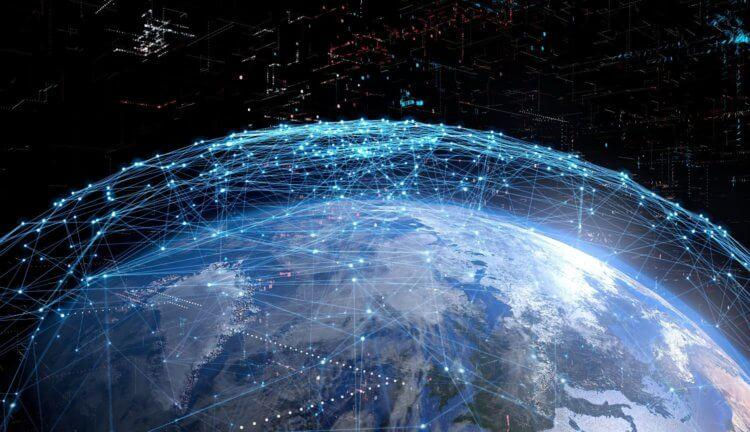
It also makes perfect sense for SpaceX to enter this market, not only because of how economical the Falcon 9s are, but also because of the fact that they are striving to make the rocket manufacturing process much more value-for-money. Needless to say, SpaceX is also miles ahead of its competitors who are providing internet services, such as, OneWeb and Amazon, when it comes to rockets.
Seeing this potential return, the Ontario Teacher's Pension Fund had invested US$ 1.3 billion in SpaceX.
As with anything, though, several concerns have been raised regarding the constructions of such mega-constellations. The opposition is mainly because it's anticipated these constellations would leave a lot of debris in space, which would make life difficult for researchers and astronomers. These might also affect radio astronomy. SpaceX is trying to solve these issues and only time will tell whether they will be able to address these concerns.
Musk, however, is optimistic about its prospect and in one of the investor meetings in 2019, even suggested that this venture might start giving annual revenues of US$ 30, which could be utilised for the greater purpose - to build rockets and make Project Mars a success.
In fact, there are plans to take just Starlink, the satellite internet division of SpaceX public through an IPO, sometime in the near future. However, Musk is strict and quite adamant about not taking SpaceX public until they are "flying regularly to Mars."
This probably tells us that SpaceX is not just any business venture for Musk. It has stemmed from Musk's innate passion about space exploration and he would like to take it till the very end. In fact, he has already made quite an impact, by showing that launches can be made within one-fifth to one-tenth of the costs that are being borne currently. In fact, he wants to reduce it further and if he is successful in doing that, it might potentially change the course of space travel.
However, space transportation is a price inelastic market, and would not lead to profits overnight, and Musk would have to wait till the citizens of this planet actually take a fancy to space travel. Till then, he would definitely hope and even expect Starlink to drive the much needed cash inflow.


Comments