Earth Is Still Closed: And Business Still Down
- BizzNeeti

- Apr 14, 2020
- 16 min read
For most companies, the idea of a technology behemoth like Google announcing that a version of their main product is banned because of security vulnerabilities would be a disaster.
Though, oddly enough, the Zoom leadership is relieved. Zoom, championing the freemium model of earning revenue, normally hosts about 10 million people on its platforms daily. However, this number has exploded to rise to 200 million people, with a huge majority of them being hosted for free, ever since most countries have imposed lockdowns for citizens and businesses made working from home mandatory for employees across the globe.
Market data reveals that first-time installations of Zoom’s mobile app have skyrocketed 728% since March 2, 2020.
This inevitably led to some security issues that had been less critical when most Zoom users were businesses with IT departments, and security protocols became big problems for free, consumer-level users.
In our previous article, we tried to illustrate a few trends that took shape due to the Covid-19 pandemic and subsequent nation-wide lockdown. No points in guessing how important a role this scenario would play in the b-school case studies, not only this year but also in the years to come!
Here, we talk about a few more such trends and disruptions.
…
What’s Eviler: Covid-19 or Hunger?
Different people view the lockdown through different lenses. While some look at it as an opportunity to stay home and recharge, kids look at it as an early summer vacation. While some want to take this time to reconnect and spend more time with their families, some want to use this time to upskill themselves or pursue hobbies.
But there are also people who are faced with an unexpected question. What’d give them an easier death: Covid-19 or Hunger?
With the Covid-19 situation not seeming to have any solution in near future and further lockdown measures inevitable, there is a sizeable section of the Indian population facing severe jolts to livelihood. For the urban-informal sector workers and the agricultural labourers who have left their hometowns, lockdown means loss of job.

For this section of the workforce, income is hand-to-mouth, and with zero savings, lockdown can be life-threatening. In fact, the inflationary impact of the lockdown is bound to hit them the most.
Not only this, there are other examples of life-threatening disruptions that are difficult to account for in a blanket imposition of the lockdown. There were reports of the Railways delivering camel milk from a village in Rajasthan to an autistic child in Mumbai when the issue caught the attention of an IPS officer on Twitter. However, there are bound to be countless other examples of similar issues that people in everyday lives face but don’t catch the eye of the media or the administration.
This, combined with the tanking of the economy due to a standstill situation in industry has prompted PM Modi to change his stance from “Jaan Hai Toh Jahan Hai” to “Jaan Bhi, Jahan Bhi”, which indicates that the focus in lockdown 2.0, if any, would not only be on saving lives, but also on sustaining livelihood simultaneously.
The central and the various state governments have taken it upon themselves to keep the poor and needy fed. Apart from distributing food packets and groceries for free, governments have initiated direct cash transfers to the eligible. The Finance Ministry enlisted cash transfers to eight sections under the economic relief package.

Various benefits have been awarded to 8.69 crore farmers eligible under the PM-KISAN, 5 crore families of daily wage workers under the MGNREGA, 3 crore people over 60 years of age, widows and physically handicapped under the economic package and 20 crore women Jan Dhan account holders.

Other benefits have also been announced for 8.3 Ujwalla scheme holders, 7 crore households through women self-help groups, 80 lakh employees in the organised sector through the EPF, and 3.5 crore registered construction workers.
At the state-level, Delhi government on Friday transferred Rs 5,000 each to eight lakh beneficiaries under widow, differently-abled and elderly pension schemes while promising to transfer another Rs 5,000 in the first week of April. The Bihar government has also announced such cash transfers for its migrant workers stuck in other states.
…
The Economy Takes A Huge Hit
Economic activity has come to a virtual halt barring the essential services like food, healthcare and Internet, TV and Radio services during this lockdown. The Indian economy has subsequently taken a huge hit, with estimates pegging the setback due to the 21-day lockdown and another seven additional days to adjust and restart activities to the tunes of Rs. 8.76 lakh crore.
Correspondingly, Goldman Sachs now forecasts that India’s real GDP growth could fall to 1.6% in FY21 compared to its earlier projection of 3.3%. This is still much better than the predictions for a 2% contraction in the world GDP, a 6.2% contraction in the US GDP and a 9% contraction in the Eurozone GDP.
In all, the 420-basis point loss is said to be in part due to a decline in global growth and the elasticity of India to this global slowdown, shaving off 150 basis points, and the local lockdown and a scenario of a staggered exit are estimated to contribute a slide of another 220 basis points. The remainder of the drop is completed by investment spillovers from the global and local disruptions.
There exists considerable uncertainty about the duration and depth of the crisis but one thing is becoming increasingly clear, dealing with the after-effects of Covid-19 will be a three-pronged economic challenge over the next few years:
With economic activity at a stop, the government revenues are expected to fall drastically, while the government spending is expected to rise given the stimulus and relief packages announced. It is almost certain that the government will not be able to adhere to its fiscal target for 2020-21 and will most likely breach it by a big margin.
There are calls from corners of the RBI to finance this government deficit by printing money. However, monetisation of the fiscal deficit will lead to inflationary pressures, which is even more undesirable given the current pandemic and hysteria. The government must find another way to finance its fiscal deficit.
Banks and NBFCs are expected to witness a steep rise in non-performing assets despite the extended moratoriums and rate cuts mandated by the RBI to fight the economic downturn during the lockdown. Rising NPAs will erode the capital of lenders at a time when they are expected to lend aggressively to revive economic growth. With stock markets being highly volatile and tending to reach new lows every day, it will be difficult for banks to raise capital and the already strained government would not be able to recapitalise the public sector banks. Forbearance or tweaking of capital requirements at this point might lead banks on the road to extend-and-pretend once again, which gave rise to the problem of ballooning NPAs that we currently face since the past year and a half.
Not all is dark however. As global supply chains and production units shift and adjust to the post-Covid China, it presents a great opportunity to court international players for India. For example, Japan has laid out a USD 2 billion plan for Japanese firms to shift manufacturing out of China, Japan’s biggest trading partner under normal times, with imports being reduced by more than half lately. India, by setting up SEZs, can very well turn the situation in its favour.
…
Markets in Mayhem
Business is hit hard. Contracts and M&As are being flouted based on force majeure or Act of God, while insurance companies strive hard to not accept this to service business interruptions insurance claims for loss of profit. While the RBI has mandated banks and NBFCs to offer a three-month moratorium to debtors, the government is also likely to bring in an ordinance deterring any new insolvency proceedings being registered for the next six months.
However, any of this does not stop investors from routing the stock markets. Stocks are nose-diving, with circuits being broken on multiple occasions in the past one month. Companies like Tata Sons and Mahindra have engaged in huge stock buybacks in an attempt to consolidate ownership pattern and also prevent value from being eroded at the same time.
The past couple of days have seen huge intraday swings, with the highest rise since the 2008 recession being immediately followed by a steep fall coming in this week. However, probably the only stocks to have consistently performed better than the rest of the market have been FMCG and other essential services company stocks.
While other blue-chip stocks have lost value by as much as 80%, FMCG stocks have held their own, losing only 30%-40% and also recovering post that. The only other stocks to do well are obviously pharma companies involved in testing kit, drug, vaccine development for Covid-19.
The Serum Institute of India has made gains due to news of its vaccine for Covid-19 getting ready for pre-clinical trials.

Panic buying of kitchen essentials has ensured high sales in whatever time allowed during the lockdown, the only deterrent on higher sales being inventory running out due to disruptions in supply chain. Due to this, grocery retail chains like DMart and Future Group have done well on the market. In fact, DMart stock has advanced 24%, making owner Radhakishan Damani the highest gainer on net worth among the Indian billionaires.
…
Automobile Industry in Peril
Covid-19 has struck at a time when both the Indian economy and the automobile industry were hoping to recover from a year that was characterised by a slump in growth. The automobile sector contributes to around 7.5% of the Indian GDP and about 50% of the manufacturing GDP.
While the absolute impact can only be gauged after sometime, depending on how long the lockdown continues, it is estimated that the plant closures by automakers and their suppliers would lead to a daily loss of $305 million and an overall revenue impact of at least USD 1.5 -2 billion per month across the industry.
Even before the lockdown started in India, the supply chain disruption in China had plagued the industry. China accounts for 27 per cent of India's automotive part imports and major global auto part makers. This had led to delays in production and delivery of BS-IV compliant vehicles. The impact of the supply chain issues was quite global, with even Tesla having to deliver their Model 3 sedans after installing sub-par components.
While functions such as HR, Planning, R&D, Finance – essentially the white-collar jobs - are being performed remotely, production lines are halted and blue-collar workers are asked not to come to work, though they have been promised full pay. The industry has thus come to a standstill, as production is the primary and most important function here. This has shown the importance to upgrade the production lines from semi-autonomous to a more autonomous or remotely controlled one.
While the effect has been slightly lessened by the fact that the Supreme Court has ordered an extension of 14 days of sales of BS-IV after the lockdown ends to clear out unsold inventory, the impact due to the Covd-19 situation has been quite stark and apparent.
…
Fuel and Energy Demand Fizzles Out Too
Fuel consumption globally has taken a huge hit, led by China, world’s largest importer of oil and India, world’s third largest importer of oil, under severe lockdowns and standstill of economy. Crude oil prices have nosedived, and accompanied by OPEC+ increasing production to sell more to make up revenues, they need to cut a deal among themselves and get prices back up. Reports even suggest at this rate, prices could dive even below USD 0. However, this works well for India, by way of cutting fuel import costs and also saving valuable foreign exchange.
Fuel consumption in India shrank by 18%, the highest in a decade. The demand for petroleum products contracted by 17.79% to 16.08 million tonnes, because of reduced demand for petrol, diesel and air turbine fuel (ATF). Demand for diesel, the most consumed fuel in the country, fell by 24.23% to 5.65 million tonnes. This the highest ever fall in consumption of diesel that India has ever recorded, as trucks and other commercial vehicles have stopped plying.
The energy consumption has also seen quite a huge fall, going down for the first time in three months. The percentage fall in daily energy consumption itself has grown from 15 per cent to 26% during the period from 18th March to 28th March, i.e, from 3586 GWh to 2652 GWh. The spot price also fell to a three-year old low of 60 paise on 25th March on the Indian Energy Exchange, and is currently hovering around the Rs. 2 mark, thus piling more pressure on the already ailing distribution companies. These discoms are slated to face severe working capital issues if this continues.
…
Indian Pharma Leading the Way
While the pharmaceutical industry works tirelessly towards the development of drugs and vaccines for Covid-19, doctors have been able to use a few combinations of existing generic drugs to treat people successfully. Particularly as hydroxychloroquine, a drug commonly used to treat symptoms of malaria, proves to be more successful than the rest of generic drugs in the current pandemic, affected countries try to procure sufficient amounts of the medicine.
Here, India comes across in a position of power since it happens to be the producer of over 70% of global output of the drug with production capacity readily expandable. While the government initially banned its export, it has lately been involved in deals and negotiations to hold the drug as leverage in helping diplomatic, strategic and trade allies and make inroads with nations in need of the drug.
Particularly, India has been able to get the US government to ensure favourable terms and approval of certain banned drugs from the Indian pharma companies in the US in exchange of allowing the export of hydroxychloroquine to the US.
Interestingly however, 80-90% of the Indian pharma firms that produce hydroxychloroquine are themselves dependent on China for the supply of the Active Pharmaceutical Ingredient used for its production. This supply has virtually dried up, and the API available for Rs 80,000 per kilogram before the crisis, is not available even for Rs. 1,50,000 per kilogram now.
…
Technology: A Faithful Ally
The department of Science and Technology has earmarked Rs 56 crore for start-ups working on on Covid-19 solutions under the “Centre for Augmenting WAR with Covid-19 Health Crisis” (CAWACH) programme. Under the same, it has decided to financially back Seagull Biosolutions for efforts to develop a coronavirus vaccine and produce test-at-home kits to detect even non-symptomatic infections.
India has received heavy praise from the WHO for the way the government has handled the pandemic. In focus now is the effort by the government to use technology to fight Covid-19 with better speed and efficiency.
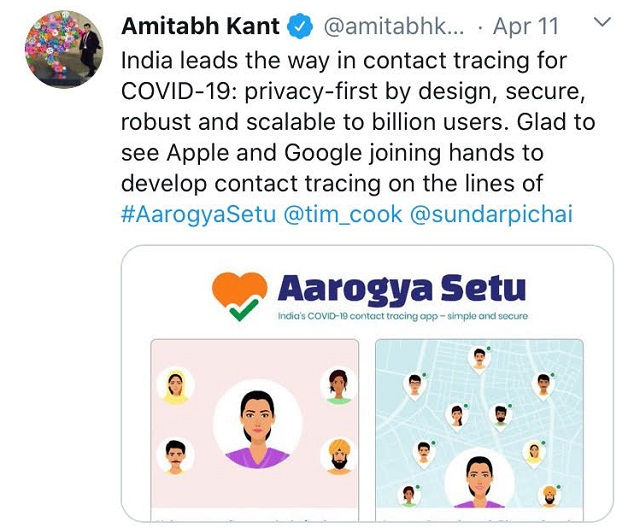
The NIC has launched a mobile application “Aarogya Setu”, a voluntary solution for contact tracing and prevention of spreading of the virus. This is extremely useful in efforts toward preventing community spreading. Moreover, tech giants Google and Apple have reportedly joined hands to build something on similar lines also.
IIT Guwahati teams have come up with drones for disinfection of larger areas, while another group has come up with drone equipped with infrared camera which can help in thermal screening of groups without human intervention and identify suspected COVID-19 cases at an early stage once the lockdown is lifted. A team from the institute has developed two robots which can be deployed in isolation wards for COVID-19 infected cases for delivery of food and medicine to patients and collection of contagious waste.
While IIT Ropar has developed a trunk-shaped device fitted with ultraviolet germicidal irradiation technology, an IIT Bombay start-up has developed a "digital stethoscope" that can listen to heart beats from a distance and record them, minimising the risk of healthcare professionals contracting the novel coronavirus from patients.
The digital stethoscope device to reduce risk to doctors and other medical professionals is not only genius, but very necessary. This, along with enhanced availability of both disposable and reusable PPEs is extremely important to protect these frontline soldiers from contracting the virus themselves.
Though the central and various state governments have announced and implemented sponsored insurance schemes in the face of casualties, which shows the government is well aware and responsive to the risk involved, we need to focus on prevention more than financial support later. While there are an ample number of MPs and corporates contributing with PPEs and other support for medics, there have also been cases of doctors protesting due to sever lack of PPEs in a few Covid-19 dedicated hospitals. There have also been reports of cases of senior doctors not reporting for duty, which should be looked into as soon as possible.
…
Healthcare and Internet
Huawei has expressed interest in helping the Indian government setup 5G infrastructure so as to leverage technology to fight this deadly disease. While a major reason behind this is to gain foothold in one of the largest markets in the world, the fact that technology, if deployed correctly, can help mitigate this pandemic, has also been proved.
In China, Huawei's 'AI + Doctor Review' has helped to easily diagnose the disease, and has proved to be a dozen times faster than manual quantitative image detection. Their 5G + Thermal Imaging helps in contagion monitoring, accurately monitor a moving object's temperature in real time and issue alerts. 5G networks would also make remote consultations and telemedicine much more effective.
The state government of Kerala has also started to leverage telemedicine services, through which specialist doctors in a range of disciplines, from general medicine and paediatrics to ophthalmology and ENT, can be contacted from 2 pm to 6 pm through video calls or voice messages.
Telemedicine is already starting to play an important role in India's fight against Covid-19. The Union Health Ministry has allowed medical practitioners to serve patients remotely or through platforms like Practo and mPhine among others. However, the advice has to come directly from the doctor and not an AI system, however doctors onboarded after proper due diligence can leverage AI during counselling. This would be helpful not only during this period, where telemedicine services can help the doctors by reducing chances of contraction and help them to smoothly manage patients and even prioritise if needed, but also in the longer run, by helping treat patients in the remote areas.
…
Stay at Home: Work Goes On
Pope Francis' sermons and the papal services during the Holy Week have been live streamed. Top events around the world, including Google's Cloud Next 2020 and Facebook's F8 Developer Conference are being planned to be held digitally, which would include streamed video, content, keynotes, interactive learning, as well as AMAs.
The verdict is already out: Yes, all those meetings could have been emails. Anticipating a lockdown, most corporates tested their Business Continuity Plans, including even manufacturing firms for functions like Planning, Supply Chain Management etc., and Covid-19 can oddly be declared as the leader of their digital transformations.

Video conferencing solutions providers have stood to gain a lot from the ongoing pandemic situation across the world, with businesses having to adopt such digital means of collaboration for employees working from home. They too have taken this opportunity to expand their customer base as much as possible, with leading services like Google Hangouts, Microsoft Skype, Zoom and Cisco WebEx offering free services in the wake of lockdowns.
However, since VC platforms are running way above capacity originally planned for, they are facing issues, most commonly on the security front. There have been cases of vulnerabilities, for example, resulting Zoom being banned in Singapore. This underscores the importance of cyber security even as more and more people go online, and firms even evaluate performing a lot of functions digitally even after the lockdown is over to save costs and optimize processes.
…
Stay at Home: Learning Must Not Stop
Not only corporates and businesses, but even schools and colleges are using video conferencing to carry on with classes and lectures so as to minimize the effect on academics. However, issues like low availability of network, and non-compatibility of older devices have proven to be obstacles in the regionally and economically diverse student pool of India. Moving forward, we need to democratize the whole exercise and think of solutions that would encompass the marginalized sections of the society also.
An important part of digital learning, ed-tech platforms, are on a bull run. BYJU's, leader in this segment, announced on March 11th that it has made all learning material available to the students of classes one through twelve until the end of April. Competitors Toppr, Vedantu and Unacademy have also come up with their own promotional offers to capitalize on the opportunity presented by the lockdown. While the future for ed-tech looks exciting, at its current state, it isn't really a substitute for in-class experience. These companies should use this time to take reviews from the increased user base to streamline content, rejig lectures, and even forge partnerships with schools and colleges to provide solid alternatives to the in-class experience and make inroads across all demographic and regional segments of the student population in India.
…
Stay at Home: Keeping Oneself Entertained
With people now staying at home, TV viewership and advertising have increased by leaps and bounds. Doordarshan leads the wave with weekend numbers in excess of 150 million screens riding high on the success of its retelecasts of shows like Ramayan, Mahabharat and Shaktimaan.
While OTT video platforms are expected to do well, OTT Audio is set to take a big hit because of drastically reduced commuting times, the time most users stream music.

According to a survey conducted by InMobi, 46% viewers are watching more content online, while another survey by Hammerkopf has found out that the OTT consumption time has gotten extended: from 10PM-12AM to 7PM onwards. This can be intuitively explained, as the extra three hours is basically the commute time that has been saved.
In order to reduce congestion and ensure the essential services can run without any disruptions, content providers including Hotstar, Sony, Balaji, Netflix, Amazon et al had unanimously decided to cutdown HD (1080p & 720p) bitrate to SD (480p).
Thus, while there is extensive engagement for the OTT platforms, they would also have to up the ante and keep the viewers engaged with fresh content. While Zee5, Voot Select and AltBalaji have had a significant spike in user base, Netflix and Amazon Prime Video are expected to even retain quite a few of these added subscribers, and end up doubling the number of subscribers. Hotstar's increase might be around 20%-25%, considering that it already has a huge subscriber base, while it plays with a sticky wicket due to the cancellation of this year’s IPL, probably Hotstar’s biggest attraction. To balance things out, Disney+ was launched and has been made accessible through Hotstar.
…
Corporates doing their bit
In a move that is expected to encourage donations and other help in kind from corporates and other businesses, the government has notified that any financial effort made by firms would be eligible under the mandatory CSR spend quota.

Companies with active hyperlocal and last mile delivery networks, like Zomato, Swiggy and Dominos have started delivering groceries, something not aligned with their initial business models. Not only this, they have been actively involved in providing relief, distributing food packets to the needy. The recent campaign by Swiggy, in partnership with the I-PAC in Uttar Pradesh, is one of many examples.
Automakers like Maruti, Tata and Mahindra have been actively using their idle production capacity and supply chain to manufacture and deliver ventilators and PPE kits. Not only this, firms like Maruti, Tata Sons have also been helping smaller authorised firms scale up their own ventilator and PPE manufacturing operations lately.
…
Way Forward: As the government
Preparedness is the key. India was fortunate enough to have received and heeded to early warnings about this virus, and have so far been fairly successful in handling the situation. However, had things been a bit worse, India, with its huge population density and public appetite to create panic and disobey government advisories unless force used, could have well been at a position worse than Italy and the US.
This must prompt the government to lay more focus on biological threats and even look at better preparedness for both defence and offense in bio-warfare.

Bhilwara, a district in Rajasthan, however, stands out in terms of administrative process followed to contain the infection effectively. Officials there followed a three-step approach:
hard application of curfew and sealing of borders
door-to-door testing campaign
strict isolations and quarantines
While this may seem fairly intuitive and common-sensical, it is very difficult to implement such a strategy in a country as diverse, populous, dense and economically bifurcated as India.
Here, India could take a leaf out of South Korea’s and Singapore’s booklets, both of which developed viral response and containment strategies after facing the brunt of the SARS outbreak earlier. They have built extensive capacity for thorough testing of patients and suspects. People are advised to volunteer for tests even if they feel slightest of the symptoms. People advised quarantine and isolation are checked upon multiple times a day by use of mobiles, and heavy fines are imposed on those found in violation.
With innovative strategies like drive-through and walk-in test counters with minimal workforce, reduced testing times and vast availability of testing kits and other infrastructure like PPEs and isolation facilities, South Korea has been able to avoid a pandemic.
Way Forward: As the industry
Covid-19 is changing the way we are doing business: by adopting the "new normal" to be the way to go about things.
These are weird times indeed. The world has been under the cover of a pandemic since almost a month now. With India, and the most parts of the rest of the world, under a self-imposed lockdown to arrest the spread of and possibly prevent coronavirus from wreaking any more havoc, no amount of planning and strategizing has been able to help businesses to run affair without hiccups. While some businesses have come to a complete standstill, some have made windfall gains, owing simply to the nature of the businesses.
That's the reassuring lesson in these trying times. Change is scary, and many businesses are experiencing significant disruption. Business’ best bet now is to try and view every disruption through the prism of how it might help it troubleshoot, improve and prepare for the future, for hopefully, it is not a full-stop but a mere comma in the success stories.


Comments