Urban Unemployment: A Mare's Nest
- BizzNeeti

- Aug 14, 2020
- 5 min read
While monsoons in 2020 have been a cause of much distress for city dwellers from Mumbai to Kolkata, it has been a boon for Kharif crop season in agriculture heavy rural parts of India. The season has resulted in 88% higher sowing as compared to the previous year.
Good monsoon season and consecutively higher agricultural activity has been instrumental in drastically reducing rural unemployment from 17.7% to 7.7% from June 2020 to July 2020.
However, the harder hit this time is the urban employment rate. Although practically the same as that of rural India, during June, urban unemployment has only come down to 11.2%. Low economic activity in the wake of the Covid-19 due to dense populations and a halt in factory operations, construction work not ignoring increased pink slips in high skill corporate jobs are some of obvious factors for the situation. While over 122 million Indians lost their jobs between March-April 2020, unemployment rate in India reached the peak of more than 27%, with urban unemployment at the time being 29.2%.

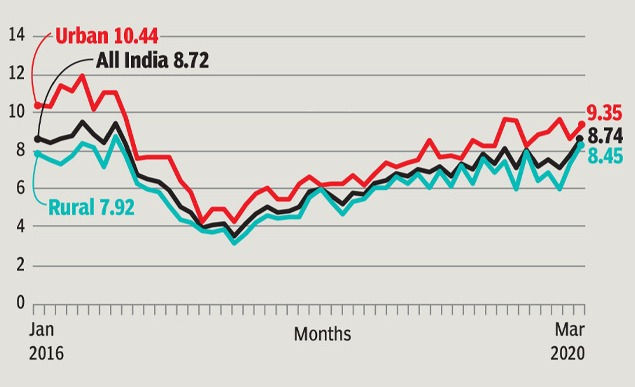
Thanks to the revival, since the peak, the rate has come down by almost 20%, coming slightly near the pre-pandemic rate of 6.6% during the last week of January. Although the trend is positive and unemployment is decreasing, it raises the question, what more can be done to control unemployment in urban areas, a problem that has been seldom thought about, given the false notion of urbanity being linked to prosperity. We say it’s false because looking at unemployment trends from Jan 2016 to Mar 2020 when the world seemed safer, unemployment in the urban areas was consistently higher than that in rural India. Jharkhand, Odisha, Himachal Pradesh and Kerala are some of the states taking initiatives to address this question.
Discussing in context of Jharkhand, the idea of Mukhyamantri SHRAMIK (Shahri Rozgar Manjuri For Kamgar) Yojana is to be able to tackle the large influx of migrant labour force and helping more than 25% urban poor households who were earlier employed as casual labourers and have now been impacted by the lockdowns. Derived on the lines of MGNREGS that focuses on employment guarantee for the rural poor, the work engagement will last anywhere between 7 to 100 days with a minimum wage that is yet to be decided upon, however is likely to be 40% above what is provided in MGNREGS. At the same time, unemployment allowance will also form a part of the policy, which would mean that under the scheme, if the beneficiary is not tied to a job, they will still receive a percentage of the minimum wage (full for the third month of no work).

Apart from creating jobs, this policy can offer some indirect advantages such as:
A formal route to recruit unskilled workforce for the employers will keep the wages in check.
Increased employ-ability and skill development of the urban poor will help them raise their own employment opportunities for the remaining part of the year.
The government which earlier would have had asset development, constructions tasks, stuck in the pipeline can now make use of this opportunity to expedite them, and fulfill the targets they have to meet, at both ends, ensure urban employment and simultaneously complete pending projects.
However necessary for survival, more so, in the times of an economic slowdown like that caused by Covid-19, guaranteed wages are are prone to exploitation as an opportunity to earn a free meal.
There have been times when I would hear house-help(s), construction labourers employed at people’s houses/offices, factory workers taking a few-months long vacations to visit their villages. As a kid, the thought that they are willing to sacrifice 2 months’ worth of salary to do that was astonishing for me. But then I came to realise that a lot of them go back to their villages and register under MGNREGS. Since the government cannot arrange enough employment for all the registered villagers, it is highly likely that most of them will be able to benefit from the guaranteed wages program, practically earning without working, which at least helps them get through basic expenses which are anyway less in a rural settlement. At the same time, they benefit from the medical and social security measures that come along with the scheme. What a loophole to exploit, especially one that hinders the government from achieving some of the indirect advantages talked about. But again, this is not to say that there aren’t people who need the external help to at least subsist, if not sustain and guaranteed wages are the necessary evil we need in difficult times.

Talking about loopholes, it happens with such policies that the intended beneficiaries are not the only ones to benefit from them.
In 2012, news publishers ran claims that alleged almost 10 Lakh (1 Million) ghost beneficiary accounts to be existing in Karnataka leading to more than Rs. 600 Crore in losses. Again, in Karnataka in 2017-18, 596 cases were registered against individuals for violating the regulations laid out under MGNREGS.
The good thing about a separate scheme for the urban context is that fewer labourers will now be able to exploit the rural scheme, especially when they are already employed in the city. This will lead to better opportunities for their rural counterparts. At the same time, once all stops are open, urban areas should not have a dearth of employment opportunities for unskilled labour. Simultaneously, incorrigible officials and individuals will find another opportunity to exploit the scheme making strict implementation inevitable.
Is it possible to extrapolate this scheme nationally? There are two boats that are considered when talking about national implementations of such projects.
One is subsidising, and second is generation of opportunities in the lack of which one can be supported through guaranteed income.
The current model comes with Subsidies on food (through Public Distribution System), fertilizer and agri-equipment, petroleum coupled with MGNREGS, collectively accounting for ~3% of GDP alongside schemes like Awas Yojana (Housing) or Jan-Dhan (Banking). To bring about guaranteed basic income could mean pulling some budget out of such schemes possibly causing disruption in these areas of subsidies.
Additionally, since jurisdiction of most of the tasks within a state lies with the state governments, it is easier for state governments as compared to the central government to independently identify employment opportunities and employ a labour force. Whereas, the centre could be better off supporting through stimuli based on subsidies and guaranteed wages. However, it goes without saying that a collaborative effort between the two could be one way of implementation can be one way of looking at the solution, like we have seen in the Swarn Jayanthi Shahari Rojgar Yojana started back in 1997. Secondly, at the time when there are much lower opportunities that can be generated, starting small with few states like Jharkhand and then scaling up can help us determine the viability and analyse the possible improvements to the implementation, in which case Jharkhand would be a pioneer that every state will follow.


Comments